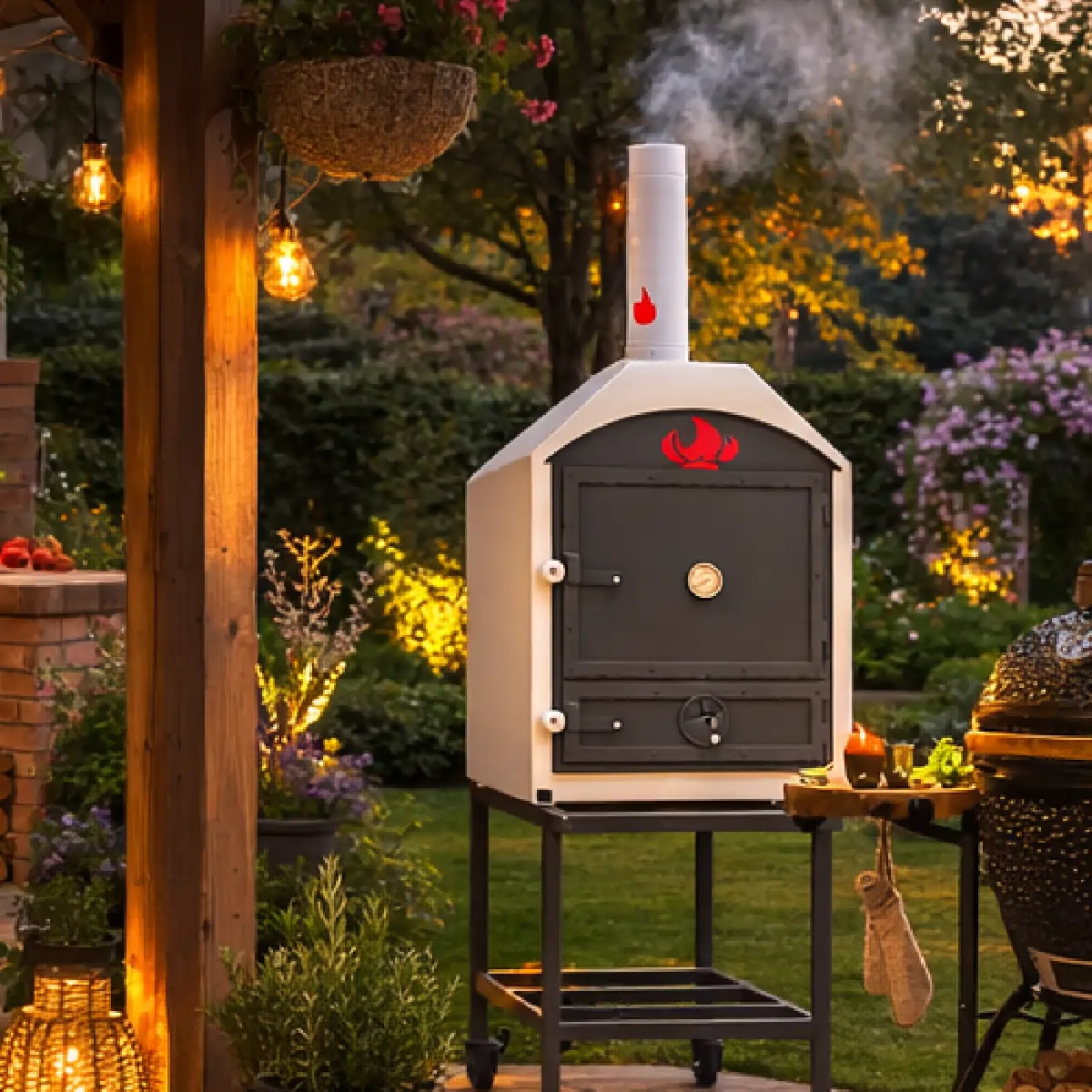
Image description: Tynker mobile heat-storage wood-fired oven with top or rear flue exit, showing chimney planning and installation considerations. Image title: Top or Rear Flue Exit for a Mobile Wood-Fired Oven. Image description detail: hero image for an article about top and rear flue exit options, including installation and safety considerations.
Top or Rear Flue Exit? How to Plan Oven Placement the Right Way
This is not a small detail. It is a decision that affects draft, safety and everyday comfort in real use.
When choosing a mobile oven, most people look first at size or design. But one of the most important questions often appears only during installation: where should the smoke go? The right solution gives calmer operation, better burning behaviour and more predictable everyday use.
To understand the basic system behind it, we also recommend what a heat-storage wood-fired oven is. If you want to look at the full installation logic, continue here: mobile oven delivery, placement and installation.
Top exit – natural and simple
With a top exit, the chimney rises directly upward from the upper part of the oven. In airflow terms, this is the simplest and cleanest route.
Advantages
- more natural, stronger draft
- simpler installation with fewer critical points
- ideal for a freestanding outdoor placement
- a good solution if the chimney should go upward above the roofline
In connection with this, it is also worth reading how a heat-storage wood-fired oven works. If pizza use is also important, add this as well: pizza oven temperature and how to bake better pizza.
Rear exit – a more flexible solution under a pergola
With a rear exit, smoke leaves through the back of the oven and then turns upward through an elbow. This can be especially useful if the oven stands under a pergola, near a wall or inside a covered outdoor kitchen.
When is it especially practical?
- under a pergola or covered seating area
- if the oven stands close to a wall
- if the chimney must be guided above the eaves
- if the goal is a system that fits more easily into the layout
To help choose the right place, also see mobile oven delivery, placement and installation. If maintenance and long-term use matter too, continue here: wood-fired oven maintenance, cracks and winter care.
What matters during installation?
- There should be a controllable chimney section near the start of the system – fine draft adjustment matters.
- The whole chimney system must be fixed securely, especially with a rear exit.
- Use only heat-resistant, properly rated chimney elements.
- Follow local fire safety rules and the required distances from combustible materials.
Related articles:
• For the internal logic of the oven: How a Heat-Storage Wood-Fired Oven Works
• For placement and stand planning: Mobile Oven Delivery, Placement and Installation
• For practical questions: Wood-Fired Oven FAQ
• For long-term use: Maintenance, Cracks and Winter Care
• For firing technique: How to Fire Up a Wood-Fired Oven
Summary: planning or improvisation
This is not an aesthetic decision. It is a planning decision. The right flue exit:
- improves draft
- supports more stable burning
- makes placement easier
- increases safety
And that is exactly the difference between improvisation and a system that works well over the long term.
For the bigger picture, we also recommend these two articles: what a heat-storage wood-fired oven is and how to choose a wood-fired oven.
Summary recommendation
If you want the oven to work as a real system, then installation and smoke routing must be thought through just as carefully as the oven itself.
Image description: atmospheric garden scene with a wood-fired oven and a well-planned chimney system. Image title: Wood-Fired Oven with a Stable Chimney System. Image description detail: the image suggests that once draft and smoke routing are solved properly, attention can stay on cooking and enjoyment rather than smoke problems.